


The quantum computing revolution isn't coming; it's already knocking at our door. Shor's algorithm threatens to dismantle RSA and ECC encryption in mere hours once cryptographically relevant quantum computers (CRQCs) arrive, while Grover's algorithm halves the security of symmetric encryption. For industries with long lifecycle products including automotive, aerospace, defense, and critical infrastructure - this isn't a distant concern. It is almost guaranteed that a vehicle or satellite launched today with fixed-function cryptographic hardware will be operational well past "Q-Day," the moment quantum supremacy renders classical encryption obsolete. The stakes couldn't be higher: without agility, we're not just risking data breaches, we're guaranteeing them.
The urgency intensifies with "Harvest Now, Decrypt Later" (HNDL) attacks, where adversaries are already stockpiling encrypted data to decrypt once quantum capabilities mature. Government secrets, healthcare records, financial data, anything with a confidentiality lifespan extending beyond the quantum horizon, is already compromised in waiting. NIST recognizes this reality, mandating crypto agility as a strategic imperative rather than a nice-to-have. However, agility baked into software alone can't meet the performance demands of post-quantum cryptography, and fixed-function ASICs are instantly obsolete the moment standards shift or new vulnerabilities emerge.
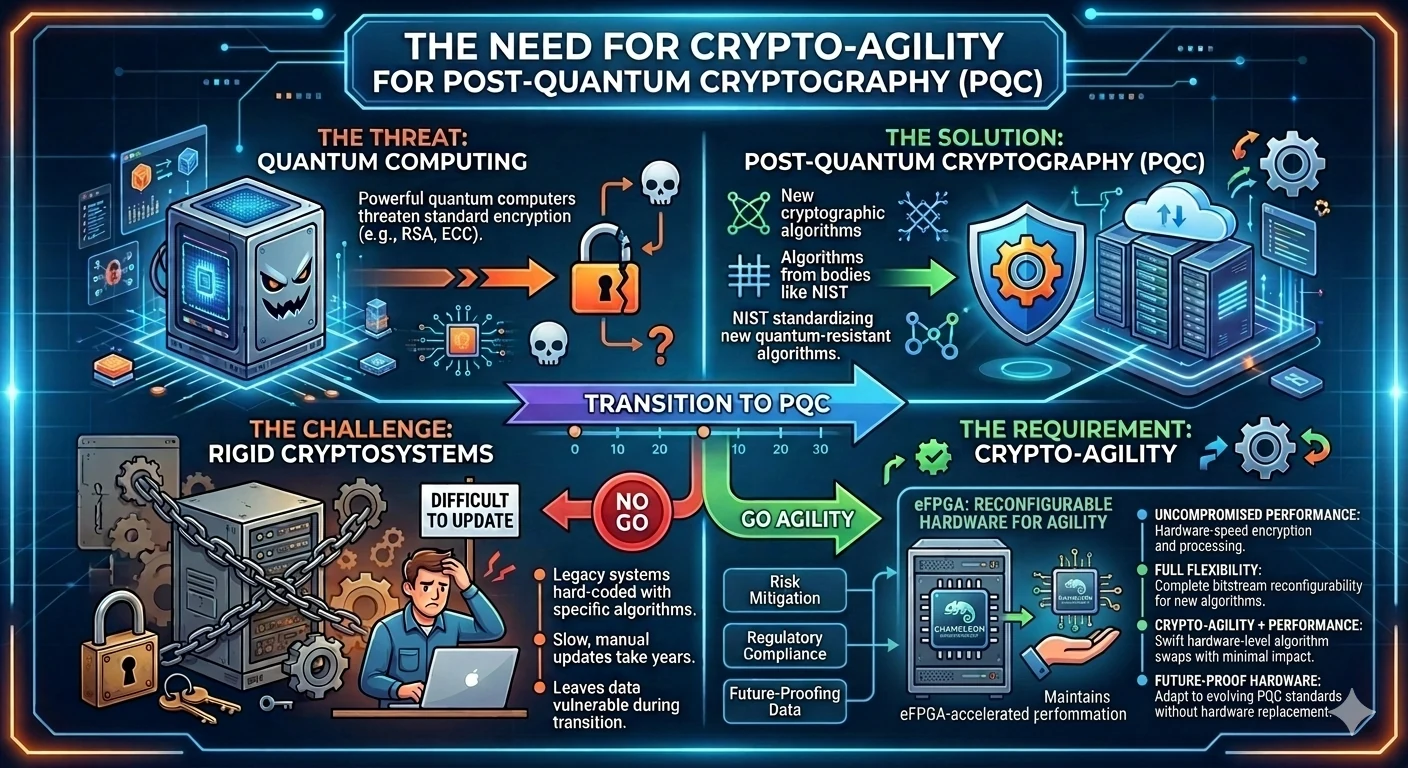
Enter the hardware trilemma. Software implementations offer flexibility but collapse under PQC's computational weight - Kyber-512 decapsulation takes ~10.5ms on an ARM Cortex-M4 versus ~15-20μs on FPGA, a 700x performance chasm. Fixed ASICs deliver speed and efficiency but become "crypto bricks" when algorithms break, as SIKE and Rainbow devastatingly demonstrated during NIST standardization. The industry has forced us to choose performance, flexibility, or security. Pick two, sacrifice the third. Until now.
Chameleon Semiconductor's eFPGA-based uniquely addresses these challenges. By embedding reconfigurable logic directly into an SoC or ASIC, Chameleon enables a hybrid approach where performance-critical operations - NTT transforms, Keccak permutations, polynomial arithmetic - are hardened for ASIC-level speed, while algorithm control flow and evolving logic reside in programmable fabric.
This isn't theoretical; it's a proven path to 600-700x acceleration over pure software while retaining the ability to update algorithms, security parameters, and even entire cryptographic families in the field via secure bitstream updates.
What truly distinguishes Chameleon as an eFPGA provider isn't just the architecture, it's the execution. Unlike embedded hard macros locked to specific process nodes and vulnerable to reverse engineering, or chiplet-based solutions burdened by complex packaging and yield challenges, Chameleon's soft eFPGA approach generates synthesizable RTL optimized for your specific application.
Our open-source-driven flow (Yosys, VTR/VPR, Chisel) enables fine-grained hardware redaction, protecting proprietary IP by "hiding in plain sight". The eFPGA structure is visible, but the critical logic is only revealed through encrypted bitstreams loaded post-fabrication.
Process-independent, reverse-engineering resistant, and supply-chain secure.
In an era where NIST itself maintains algorithmic diversity as a risk mitigation strategy, adding code-based HQC as a backup to lattice-based MLKEM, any solution that is not based on hardware flexibility and is betting on any single fixed implementation is at high risk of obsolescence. As the industry’s only US-based software defined, RTL based eFPGA supplier, Chameleon isn’t merely the best option for PQC agility; for long-lifecycle systems where hardware respins cost millions and recall is impossible, it's the only option that preserves performance without sacrificing adaptability. The quantum era demands hardware that evolves. Chameleon delivers exactly that.
Please read our white paper to learn more about how Chameleon eFPGA uniquely addresses crypto agility.