


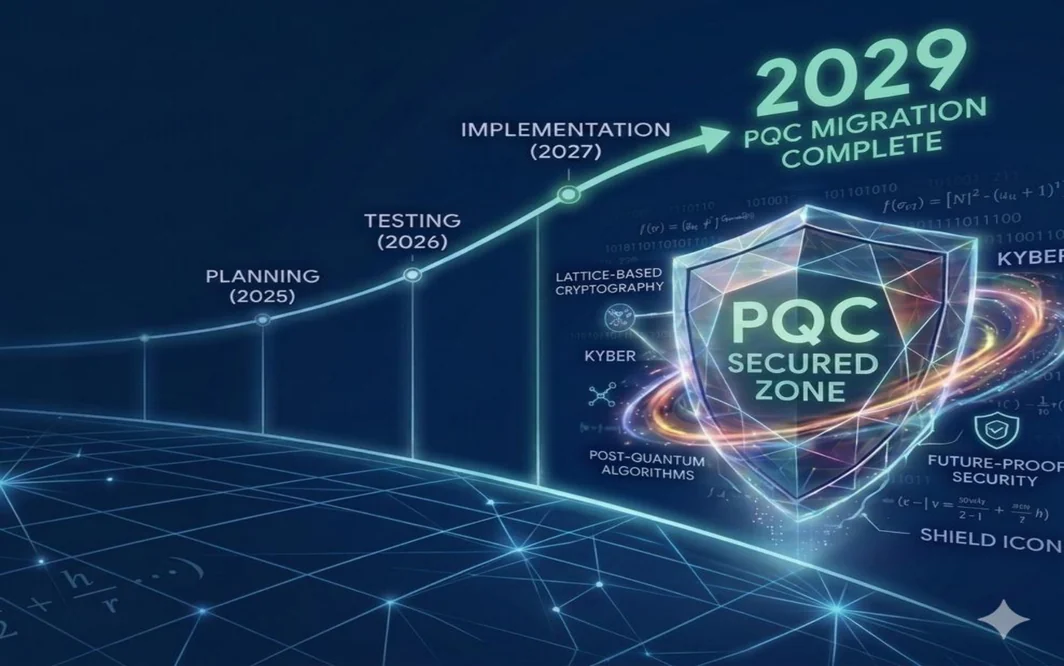
The digital security landscape shifted dramatically last month when Google announced an accelerated timeline for Post-Quantum Cryptography (PQC) migration, moving its target completion date to 2029. This shift, two years ahead of the NSA’s 2031 goal, is a response to rapid advancements in quantum hardware and error correction that could see current encryption broken much sooner than previously thought. For industries ranging from finance to critical infrastructure, Google’s "wake-up call" transforms PQC from a distant research project into an immediate engineering priority.
Google’s researchers found that the resources required to crack standard RSA-2048 encryption have decreased from an estimated 20 million noisy qubits to roughly one million. This reduction in the "Q-Day" horizon highlights the volatility of the threat; as quantum algorithms and hardware evolve, the specific PQC standards may need to change tomorrow.
This volatility is exactly why static, fixed-function hardware is not a viable security strategy.
To meet this compressed deadline, organizations like NIST have already mandated the need for crypto agility - the ability to update cryptographic algorithms without a complete system redesign. While software updates provide some flexibility, the performance demands of PQC algorithms often require hardware acceleration to avoid crippling system latency.
This creates a paradox: you need the speed of hardware but the flexibility of software. This is where eFPGA (embedded FPGA) technology becomes indispensable.
Chameleon Semiconductor eFPGAs allow developers to embed a reconfigurable logic fabric directly into their ASICs or SoCs. Unlike traditional fixed-function crypto-engines that are "frozen" in silicon at the time of manufacture, an eFPGA-based solution can be reprogrammed in the field.
If a NIST-standardized algorithm like ML-DSA is found to have a vulnerability in 2027, a system based that employs a Chameleon eFPGA can be revised with a new hardware-level implementation in minutes, rather than requiring a multi-million-dollar ASIC spin.
Ultimately, Google’s 2029 mandate proves that the "one-and-done" approach to security is dead. The future of digital trust belongs to those who design for change. By integrating the Chameleon eFPGA into their core architecture, companies can achieve the hardware-level performance needed for PQC without having to compromise system level performance.
To learn more about Chameleon Semiconductor PQC solutions please visit our site and download our PQC white paper.