

At Chameleon Semiconductor, we view the shift to chiplets through the lens of silicon economics standards. The move to chiplets reflects the next industry-wide innovation required to enable the continuity of Moore’s Law. Suffice it to say, interoperability between chiplets is essential for success as the vision is that chiplets from disparate vendors are expected to interconnect like LEGOs while at the same time delivering intended functionality and performance.
Chiplets, or more appropriately, UCIe and Bunch of Wires (BoW) standards have made critical progress by standardizing die-to-die electrical signaling across several foundries and process nodes. However, a physical interface alone does not enable interoperability. The industry ultimately needs highly flexible alignment on protocol usage profiles, application semantics, discovery and capability enumeration, security and trust, debug conventions, and boot/lifecycle coordination, requirements that are being advanced across Open Compute Project (OCP), JEDEC, and IEEE.
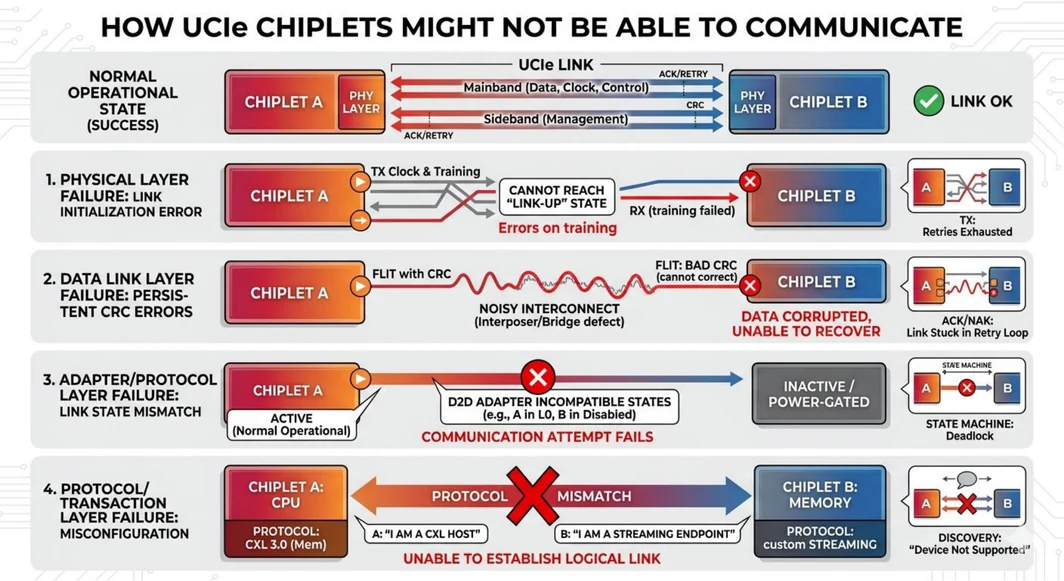
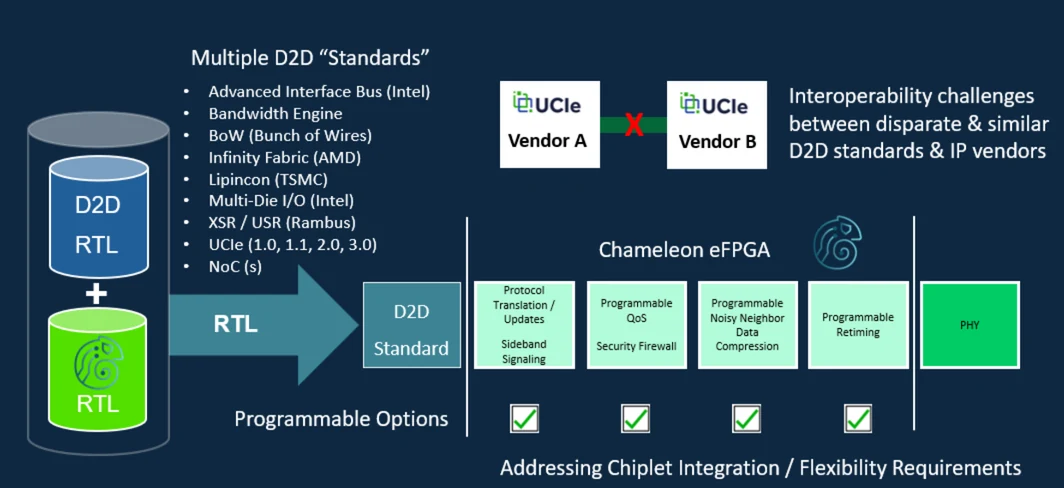
This is precisely where reconfigurable hardware, Chameleon Semiconductor eFPGAs, plays a critical role in enabling a viable chiplet ecosystem. While UCIe defines a three-layer architecture: PHY, Die-to-Die Adapter, and Protocol, the primary mismatches between chiplets and chiplet IP emerge above the PHY, in the Adapter and Protocol layers where link bring-up, flit formatting (flow control units), arbitration, sideband capability exchange, and protocol versioning must align across independently taped-out dies.
Employing Chameleon’s eFPGA fabric at these layers, system level designers and integrators can address interoperability issues by accommodate evolving standards without an ASIC respin, sustaining semantic compatibility as AXI, CXL, PCIe, and custom streams continue to evolve.
Interoperability also depends on trust. OCP’s Open Chiplet Economy work has highlighted the need for chiplet identity and provenance, root-of-trust architectures, key management, fault detection, in-package test, and debug observability, capabilities that are difficult to future-proof in fixed logic and even harder to coordinate across fragmented supply chains.
Our eFPGA supports cryptographically protected configuration and hardware-based redaction to help prevent extraction or tampering of interface logic, even when chiplets come from different vendors. When vulnerabilities are discovered or integration issues surface, customers update a secured bitstream through a configuration path rather than absorbing the cost, delay, and risk of a new mask set.
Ultimately, one of the key economic barriers to a chiplet marketplace is integration risk: discovering incompatibilities after silicon commit. We architect Chameleon eFPGA as “ASIC insurance”, a low marginal cost hedge that extends product life, protects high-value IP, and enables rapid adaptation to protocol changes, security requirements, and workload evolution.
UCIe has given the industry a common physical language; our eFPGA adds the programmable intelligence required to keep systems coherent above that layer, accelerating time-to-market and lowering the NRE burden that is currently limiting participation in the chiplet ecosystem.
Visit us at Chameleonsemi.com to learn more about our best-in-class eFPGA solutions and why you should be using Chameleon in your next ASIC design.