

I. Executive Summary
The rise of cryptographically relevant quantum computers (CRQCs) threatens to undermine classical public-key cryptography, including RSA and Elliptic Curve Cryptography (ECC). Quantum algorithms such as Shor’s and Grover’s could render these systems obsolete within the next decade, accelerating the push toward Post-Quantum Cryptography (PQC). While NIST has initiated the standardization of quantum-resistant algorithms, uncertainty in algorithm longevity, the risk of “harvest now, decrypt later” attacks, and the challenges of large-scale deployment highlight the complexity of this transition.
For industries with long lifecycle products, such as automotive, aerospace, and defense, the adoption of PQC in fixed-function ASICs creates an unacceptable risk, as hardware respins are costly and often infeasible. To that extent, NIST standards mandate crypto agility as a strategic imperative.
To address these challenges, Chameleon Semiconductor advances the principle of crypto agility: the ability to adapt cryptographic implementations in the field as standards evolve. Cryptographic agile hardware architecture integrates hardened accelerators for performance-critical functions with embedded FPGAs (eFPGAs) for flexibility. This approach delivers ASIC-level performance while retaining the ability to update algorithms via secure, over-the-air bitstreams.
Such programmability ensures that systems remain secure and compliant even if PQC standards shift or vulnerabilities emerge, avoiding the obsolescence inherent in static hardware designs.
Chameleon Semiconductor further extends the eFPGA-based solution with innovations in design automation and IP security. The open-source-driven tool flow, leveraging Yosys, VTR/VPR, and Chisel, simplifies embedding programmable logic into ASICs, enabling fine-grained hardware redaction that protects proprietary IP against reverse engineering. Coupled with a secure update framework that ensures confidentiality, authenticity, and rollback protection of eFPGA bitstreams, these capabilities strengthen both supply chain security and long-term resilience.
The strategic benefits of this programmable PQC platform are significant: it futureproofs investments, reduces time-to-market, delivering significantly higher performance than software only based solutions while enabling rapid responses to new cryptographic vulnerabilities. By aligning with NIST’s emphasis on algorithmic diversity and adaptability, Chameleon Semiconductor provides a foundation for industries to securely navigate the quantum era. Their leadership in eFPGA-based cryptographic agility demonstrates that true quantum readiness requires not only new algorithms but also flexible, secure, and resilient hardware architectures.
II. Post Quantum Cryptography (PQC)
The impending arrival of large-scale quantum computers necessitates a fundamental migration of our global cryptographic infrastructure. The very mathematical foundations that have secured digital communications for decades are on the verge of becoming indefensible. Understanding the nature of this threat is the first step in preparing for the post-quantum world.
A. The Quantum Precipice: How Shor's and Grover's Algorithms Render Classical Cryptography Obsolete
The security of today's most prevalent public key infrastructure (PKI) rests on a simple premise: some mathematical issues are exceptionally difficult for classical computers to solve. Asymmetric algorithms, such as RSA and ECC, derive their strength from the intractability of the integer factorization and discrete logarithm problems, respectively. While a classical computer would take thousands of years to break a standard RSA2048 key, the physics of quantum computation changes the rules entirely.
Two quantum algorithms represent a clear and present danger to the current cryptographic landscape:
- Shor's Algorithm: Discovered by Peter Shor in 1994, this quantum algorithm provides an exponential speedup for factoring large integers and solving discrete logarithms. A sufficiently robust CRQC running Shor's algorithm will be able to break RSA, ECC, and DSA encryption in polynomial time, potentially in a matter of minutes or hours. This capability effectively demolishes the security of nearly all deployed asymmetric cryptography and is the primary catalyst for the global transition to PQC.
- Grover's Algorithm: Developed by Lov Grover in 1996, this algorithm provides a quadratic speedup for searching unstructured data. While not as catastrophic as Shor's algorithm, Grover's algorithm significantly weakens symmetric key cryptography. It effectively halves the security strength of an algorithm like AES, meaning a 128-bit key offers only 64 bits of security against a quantum attacker. The standard mitigation is to double the key length, for example, by migrating from AES128 to AES256 to restore the security margin.
The combined impact of these two algorithms necessitates a comprehensive overhaul of our cryptographic standards, affecting both asymmetric and symmetric systems.
| Cryptographic Task | Classical Algorithm Example | Underlying Hard Problem | Quantum Algorithm | Quantum Attack Complexity | Impact |
|---|---|---|---|---|---|
| Asymmetric Key Exchange / Encryption | RSA, ECDH | Integer Factorization, Discrete Logarithm Problem | Shor's Algorithm | Polynomial Time | Catastrophic. Renders algorithms completely insecure. |
| Digital Signatures | RSA, ECDSA | Integer Factorization, Discrete Logarithm Problem | Shor's Algorithm | Polynomial Time | Catastrophic. Renders algorithms completely insecure. |
| Symmetric Encryption | AES128 | N/A (Brute force search) | Grover's Algorithm | Quadratic Speedup (O(N)) | Significant. Effective security is halved. Mitigated by doubling key length (e.g., to AES256). |
B. Defining Post Quantum Cryptography
Post Quantum Cryptography (PQC) is a new class of cryptographic systems designed to be secure against attacks from both classical and quantum computers. These algorithms are developed to run on existing classical hardware but are based on mathematical problems believed to be intractable even for a CRQC.
It is important to distinguish PQC from Quantum Cryptography (such as Quantum Key Distribution, or QKD), which leverages the principles of quantum mechanics itself to secure communication channels. PQC focuses on algorithmic resilience, making it a more practical solution for upgrading the vast majority of existing digital systems.
The research into PQC has focused on several problems related to mathematical problems:
- Lattice-based Cryptography: This family, based on the difficulty of problems like Learning With Errors (LWE) on high-dimensional mathematical grids, has emerged as a frontrunner. Lattice-based schemes offer a strong balance of security, performance, and relatively compact key sizes, which has led to their selection by NIST for the primary PQC standards.
- Hash-based Cryptography: Relying on the proven security of one-way hash functions, this family offers very high security confidence. However, implementations can be stateful (requiring careful key management, like LMS and XMSS) or result in very large signature sizes. The stateless hash-based signature scheme SPHINCS+ (standardized as SLHDSA) is a key NIST selection.
- Code-based Cryptography: These schemes, based on the difficulty of decoding a general linear error-correcting code, are among the oldest and most studied PQC candidates. While they have strong security guarantees, they often suffer from very large public keys. The recently selected backup KEM, HQC, is from this family.
- Multivariate Polynomial Cryptography: Security is based on the difficulty of solving systems of multivariate equations. This family can produce very short signatures, making it attractive for some applications. Still, its history is marred by several high-profile breaks of candidate schemes, including the NIST candidate Rainbow, which has tempered confidence in its general security.
- Isogeny-based Cryptography: This family used mathematical maps between elliptic curves and was once promising due to its small key sizes. However, the dramatic breaking of its leading candidate, SIKE, in 2022 has largely removed it from consideration for the current standardization efforts.
C. The Looming Threat of "Harvest Now, Decrypt Later" (HNDL) Attacks
The urgency of the PQC transition is amplified by a specific type of threat known as "Harvest Now, Decrypt Later" (HNDL) or "Store Now, Decrypt Later" (SNDL). This attack strategy involves adversaries intercepting and storing large volumes of encrypted data Today with the full intention of decrypting, it years from now, once a CRQC becomes available.
This approach redefines the timeline for cryptographic migration. The critical factor is no longer simply the date when a CRQC arrives ("QDay"), but the required "cover time" or confidential lifespan of the data being protected.
Information with a long shelf life, such as government and military secrets, intellectual property, financial records, and personal healthcare information, is already at risk. If this data needs to remain secure for a period that extends beyond the predicted QDay, then any of it encrypted with classical algorithms today is vulnerable to future decryption.
What makes HNDL particularly insidious is its stealthy nature. The initial data theft occurs without any immediate, visible signs of a breach. There are no ransom notes or system disruptions, as the attacker's goal is to stockpile the encrypted data.
Organizations may be completely unaware that their most valuable long-term assets have already been exfiltrated and are sitting in an adversary's archive, waiting for the quantum key that will unlock them. This transforms the PQC migration from a future-proofing exercise into an immediate operational necessity.
D. The Global Response: The NIST PQC Standardization Process
In recognition of the quantum threat, the U.S. National Institute of Standards and Technology (NIST) initiated a public, multiyear process in 2016 to solicit, evaluate, and standardize a new suite of quantum resistant cryptographic algorithms. This global effort has involved intense scrutiny and cryptanalysis from academic and industry experts worldwide.
In August 2024, NIST published the first three finalized PQC standards:
- FIPS 203, Module Lattice-Based Key Encapsulation Mechanism (MLKEM): Based on the CRYSTALS Kyber algorithm, MLKEM is the primary standard for key encapsulation, the process used to establish a shared secret key over an insecure channel.
- FIPS 204, Module Lattice Based Digital Signature Algorithm (MLDSA): Based on CRYSTAL Di lithium, MLDSA is the primary standard for general-purpose digital signatures, used to verify identity and data integrity
- FIPS 205, Stateless Hash-Based Digital Signature Algorithm (SLHDSA): Based on SPHINCS+, this is a signature standard intended to serve as a backup to MLDSA. Its security is based on different mathematical principles (hash functions vs. lattices), providing algorithmic diversity.
Crucially, the standardization process is not static. The very structure of the new PQC portfolio demonstrates an inherent understanding that no single algorithm can be considered infallible. In March 2025, NIST announced its selection of the Hamming Quasi Cyclic (HQC) algorithm for standardization as a backup KEM. NIST explicitly chose HQC, a code-based algorithm, because its mathematical foundations are different from the lattice-based MLKEM. This is a deliberate risk mitigation strategy, acknowledging that a fundamental breakthrough in attacking lattice problems could compromise the primary standard.
This strategy, in turn, implies that any long lifecycle system that hardcodes a single PQC algorithm into fixed silicon is fundamentally misaligned with the risk posture of the world's leading cryptographic body. The only way to truly align with this forward-looking strategy is to build systems capable of switching between these diverse algorithmic families, the core principle of crypto agility.
| Standard | Algorithm Name | Based On | Cryptographic Family | Purpose |
|---|---|---|---|---|
| FIPS 203 | MLKEM | CRYSTALS Kyber | Lattice based | Primary Key Encapsulation Mechanism (KEM) |
| FIPS 204 | MLDSA | CRYSTALS Dilithium | Lattice based | Primary Digital Signature Algorithm (DSA) |
| FIPS 205 | SLHDSA | SPHINCS+ | Hash based | Backup Digital Signature Algorithm |
III. The Shifting Sands: Navigating the Challenges of PQC Deployment
While the transition to PQC is necessary, the path is laid with significant technical and logistical challenges. The landscape is defined by uncertainty, complexity, and severe resource constraints, particularly for embedded systems. These challenges underscore the risks of adopting rigid, inflexible hardware solutions.
A. Uncertainty in Algorithm Longevity and Security
Unlike RSA and ECC, which have benefited from decades of public cryptanalysis, PQC algorithms are comparatively new. While the NIST process has subjected them to intense scrutiny, their security is still considered "expected, though not confirmed". The history of the NIST competition itself provides a stark warning about the potential for unexpected breaks.
The most compelling real-world event justifying the need for crypto agility was the failure of the Super-Singular Isogeny Key Encapsulation (SIKE) algorithm. SIKE was not a fringe candidate; it was a fourth-round NIST finalist from the promising isogeny-based family, having survived years of analysis. Yet, in 2022, researchers demonstrated a complete break of the algorithm using a clever mathematical attack that ran on a single core of a conventional computer in about an hour.
This was not a flaw in a specific implementation but a fundamental vulnerability in its underlying mathematical problem, rooted in a theorem from 1997. The failure of SIKE, along with the earlier break of the multivariate candidate Rainbow, proved that even our most rigorous vetting processes can miss catastrophic weaknesses. This event transformed the need for cryptographic agility from a theoretical precaution into a mission-critical requirement, proving that committing to any single PQC algorithm in fixed hardware is an unacceptable business risk.
Furthermore, even when an algorithm's mathematical foundation is sound, its physical implementation can introduce new vulnerabilities. PQC algorithms are generally more complex than their classical predecessors, increasing the surface area for implementation bugs. They are also susceptible to side-channel attacks, where an adversary analyzes physical leakage from a device, such as power consumption, timing variations, or electromagnetic emissions, to extract secret key information without breaking the algorithm itself.
In 2022, a research paper detailed a successful side-channel attack against a masked hardware implementation of CRYSTALS Kyber, demonstrating that even implementations with built-in countermeasures can be vulnerable.
B. Impact of Changing Standards on Cryptographic Code and Systems
Migration to PQC is a far more complex endeavor than any previous cryptographic transition, such as the move from DES to AES.
- Deployment Complexity: The transition requires a complete inventory of cryptographic assets and dependencies, followed by a massive reengineering effort across protocols, applications, and infrastructure. Given that past migrations have taken nearly two decades to complete, the scale of the PQC transition is daunting.
- Interoperability Issues: For a prolonged period, systems will need to support both classical and PQC algorithms, often in a hybrid mode where both are used in conjunction to ensure security and backward compatibility. This adds significant complexity to protocols like TLS and IPsec. A naive PQC integration into TLS 1.3, for instance, can increase the size of the handshake data by up to a factor of seven, impacting performance and bandwidth.
- Legacy Trap: The most acute challenge lies with products that have a long lifecycle. In sectors such as automotive, aerospace, and industrial control, cryptographic modules are often embedded in ASICs with lifespans of 10 to 20 years or more. These systems are frequently designed without any mechanism for infield hardware updates. If the PQC algorithm implemented in such a fixed-function block is broken or deprecated, the only remedy is a physical recall and replacement of the hardware scenario, which is logistically nightmarish and financially ruinous.
C. The Embedded Dilemma: Severe Resource Constraints
The resource requirements of PQC algorithms pose a significant challenge for their deployment in constrained environments. Compared to their lean classical counterparts, PQC schemes are significantly more demanding.
- Larger Cryptographic Primitives: PQC algorithms almost universally feature larger key sizes, signatures, and ciphertexts. For example, the public key for the NIST standard MLKEM768 is 1184 bytes, compared to just 32 bytes for the classical ECDH equivalent. Similarly, an MLDSA65 signature is 3309 bytes, while an ECDSA signature is 64 bytes. This increase has direct implications for storage, memory usage, and network bandwidth.
- Higher Computational and Power Demands: The underlying mathematical operations, particularly the large-scale polynomial and matrix arithmetic commonly used in lattice-based schemes, are more computationally intensive, resulting in higher latency and increased power consumption.
These increases are especially problematic for the vast ecosystem of embedded systems in the Internet of Things (IoT) and automotive Electronic Control Units (ECUs). These devices are designed with strict constraints on processing power (often running at low clock speeds), memory (with RAM as low as 64–128 KB), and power budgets. For these constrained systems, the resource demands of PQC translate directly into performance penalties: cryptographic operations like decryption take significantly longer, which increases latency, while the larger memory requirements can cause operations to fail entirely.
The severity of this impact depends on the frequency of the task. A delay during a one-time event, such as a secure boot process or an infrequent firmware update, might be tolerable. However, for continuous functions, such as an ECU needing to verify a stream of signed, real-time commands, this high latency is often prohibitive.
This reality means many of these devices, even those being manufactured today, are effectively "legacy" from a cryptographic standpoint; they lack the spare computational and memory resources to be upgraded to PQC via a simple software update, dramatically raising the stakes for designing new embedded systems with a forward-looking, hardware-first PQC strategy.
| Algorithm | Type | NIST Security Level | Public Key Size (bytes) | Ciphertext/Signature Size (bytes) |
|---|---|---|---|---|
| ECDH (P256) | Classical KEM | N/A | 32 | 32 |
| MLKEM768 | PQC KEM | 3 | 184 | 1088 |
| ECDSA (P256) | Classical Signature | N/A | 32 | 64 |
| MLDSA65 | PQC Signature | 3 | 1952 | 3309 |
IV. The Crypto Agile Mandate: Programmability as the Solution
The combined challenges of algorithmic uncertainty, deployment complexity, and resource constraints demand a new approach to cryptographic hardware design. The static, fixed-function model of the past is no longer tenable. The future of secure systems depends on embracing crypto agility, a principle best realized through programmable hardware architectures.
A. From Fixed Functions to Flexible Architectures: The Principle of Crypto Agility
Crypto agility is formally defined as the ability of a security system to rapidly switch between cryptographic algorithms, primitives, and parameters without requiring disruptive changes to the system's infrastructure. It is an engineered capability that enables systems to adapt to evolving threats and standards, serving as a built-in incident response mechanism when a cryptographic primitive is identified as vulnerable.
In the context of PQC, agility is not an optional feature but a fundamental design requirement for long-term survival. The uncertainty surrounding algorithm longevity, underscored by the failure of candidates like SIKE, and the dynamic nature of the NIST standardization process make it imperative for long lifecycle systems to have a built-in capacity for change.
This need is being recognized across industries, with major standards bodies and consortia, such as the IETF, ISO, ATIS, and the FSISAC, actively developing frameworks and metrics to guide the implementation of crypto agile systems.
B. The Hardware Trilemma: Balancing Performance, Flexibility, and Security
System architects face a trilemma when deciding how to implement PQC, forced to make a tradeoff between performance, flexibility, and security.
- Software Defined Cryptography: A pure software implementation on a general-purpose CPU provides maximum flexibility; algorithms can be updated with a simple software patch. However, this approach often fails to meet the performance, latency, and power consumption requirements of PQC, especially in constrained embedded environments. The benefits of hardware acceleration become obvious when comparing the software and hardware figures side by side. The comparison below uses the decapsulation operation as an example.
| Key Generation | Encryption | Decryption | |
|---|---|---|---|
| Software Implementation of Kyber-512 algorithm on ARM Cortex-M4 (assuming 200 MHz) | ~1.2 million clock cycles 6 mS | ~1.7 million clock cycles 8.5 mS | ~2.1 million clock cycles ~ 10.5 mS |
| Kyber-512 on FPGA | ~10–15 (µs) | ~12–18 (µs) | ~15–20 (µs) |
| Speed up on FPGA | 600 X | 700 X | 700 X |
- Fixed Function Hardware (ASIC): A dedicated ASIC provides the absolute best performance, lowest power consumption, and smallest silicon area for a specific algorithm. This approach, however, is the antithesis of agility. It is a rigid solution. If the chosen algorithm is broken or needs a parameter update, the ASIC becomes a useless "crypto brick," and the only recourse is a full, multimillion-dollar silicon re-spin.
- Programmable Logic: The ideal solution must strike a balance, combining the performance benefits of hardware with the essential flexibility of software. This is the domain of programmable logic.
| Approach | Performance | Power Efficiency | Flexibility / Upgradability | NRE Cost per Update | Side Channel Resilience |
|---|---|---|---|---|---|
| Software Only (CPU) | Low | Low | High | Low (Software Patch) | Low (Vulnerable to software-based attacks) |
| Fixed Function ASIC | High | High | None | Very High (Full Respin) | Moderate (Fixed countermeasures) |
| eFPGA based Hybrid | High | High | High | Low (Bitstream Dev. Cost) | High (Updatable countermeasures) |
C. The Architectural Sweet Spot: Embedded FPGAs (eFPGAs) and PQC Engines
An embedded FPGA (eFPGA) is an intellectual property (IP) core of reconfigurable logic fabric that can be integrated directly into a larger System-on-Chip (SoC) or ASIC. This technology provides the ideal architectural foundation for achieving crypto agility in silicon.
The optimal architecture is a hybrid model that partitions the cryptographic workload. The most computationally intensive and stable mathematical building blocks of PQC are implemented in hardened, dedicated accelerators. In contrast, the logic that controls the algorithm flow and is most likely to change is implemented in the reconfigurable eFPGA fabric.
This design provides several key advantages:
- Post Fabrication Updates: The core benefit is the ability to fundamentally alter the cryptographic functionality of a chip after it has been manufactured and deployed. A new bit stream can be securely loaded onto the eFPGA to implement an entirely new algorithm, patch a newly discovered vulnerability, or adapt to a revised standard, all without a hardware respin.
- Optimized Performance: By optimizing the most demanding operations (such as polynomial multiplication), the architecture can achieve performance and efficiency comparable to that of a full ASIC for the targeted primary algorithms.
- Updatable Side-Channel Resistance: This architecture offers a significant security advantage. Side-channel attacks are a constant threat, and new attack methods are always being researched. An eFPGA allows the countermeasures themselves, such as masking, hiding, random delays, or operation shuffling, to be updated in the field. This means the device's physical security posture can evolve to meet new threats, a capability impossible with a fixed ASIC whose countermeasures are frozen at the time of manufacture
D. Estimating the Silicon Footprint: eFPGA Resource Requirements for PQC
Providing a single, precise estimate for the silicon area required for a programmable PQC engine is challenging, as the final resource count depends on the specific eFPGA vendor technology, process node, target algorithm, and desired performance level. However, by synthesizing data from numerous academic hardware implementations, it is possible to establish a well-reasoned budget for SoC architects.
The core operations of the NIST-standardized lattice-based schemes, MLKEM (Kyber) and MLDSA (Di lithium), are the primary drivers of resource utilization.
Lightweight Implementations: For compact designs, a common approach is to implement the entire cryptographic core within the embedded FPGA (eFPGA) to maximize acceleration, rather than only offloading specific functions. The resource estimates for such an implementation depend heavily on the target hardware's architecture.
The following estimates are based on these key assumptions:
- LUT Architecture: The target fabric uses modern 6-input Look-Up Tables (LUTs), which are standard in many contemporary FPGAs. The use of older 4-input LUTs would result in different utilization numbers.
- DSP Precision: The Digital Signal Processor (DSP) blocks are assumed to be standard 18x25-bit multipliers. This word width is sufficient to efficiently handle the Number Theoretic Transform (NTT) operations central to these PQC algorithms.
Based on these assumptions, a lightweight Kyber core might require an eFPGA with approximately 1,500 - 2,000 LUTs, 450 - 500 Flip-Flops (FFs), and 2 DSPs. A similar Dilithium core, being more computationally demanding, would be larger, requiring around 2,600 - 3,500 LUTs, 750 - 1,000 FFs, and 4 DSPs. These figures are representative estimates derived from various published academic and industry implementations, and exact resource counts will vary based on the specific eFPGA architecture and final design choices.
High-performance and Unified Implementations: Designs prioritizing speed through parallelism or unifying multiple algorithms require substantially more resources than their lightweight counterparts. The final resource count depends heavily on the performance target and the specific hardware architecture.
A balanced, high-performance unified architecture supporting both Kyber and Dilithium serves as a practical example. The resource estimates for such a design are based on several key assumptions:
- DSPs: These are configured for fast integer multiplication, not floating-point, to accelerate the Number Theoretic Transform (NTT) at the heart of these algorithms. The estimate assumes standard 18x25-bit hardware multiplier blocks.
- BRAMs: The on-chip memory is composed of standard 36Kb Block RAMs (BRAMs), configured with appropriate data widths and depths (e.g., 1Kx36) to efficiently store the large polynomial vectors.
Under these assumptions, a unified core supporting all security levels could occupy approximately 20,000 to 25,000 LUTs, ~10,000 FFs, 4 to 8 DSPs, and around 24 BRAMs.
It's important to understand that "high-performance" exists on a spectrum. The figure above represents a design that balances speed and area efficiency. For context, some extreme-performance, standalone Dilithium implementations designed in academia for maximum throughput have been reported to use over 60,000 LUTs. This much larger footprint is the result of massive parallelism and deep pipelining, highlighting the significant area cost required to achieve the absolute highest speeds, which the more moderately-sized unified core is designed to avoid.
For an SoC architect planning a futureproof design, budgeting for an eFPGA block in the range of 20k - 40k LUTs, complemented by a few dozen DSPs and a flexible BRAM subsystem, would provide a robust and highly adaptable foundation. This would be sufficient to support the primary NIST standards via the hardened engine and eFPGA combination, with enough programmable headroom to implement a backup algorithm like HQC or deploy updated side channel countermeasures. It is also wise to target a utilization of 60-80% to ensure that the design tools have sufficient routing resources to meet timing constraints without excessive effort.
| Implementation | LUTs | FFs | BRAMs | DSPs |
|---|---|---|---|---|
| Kyber (Lightweight) | 1,500 - 2,000 | 450 - 800 | 0- 3 | 2 |
| Dilithium (Lightweight) | 2,600 - 3,500 | 750 - 1,000 | 0 - 4 | 4 |
| Unified Kyber/Dilithium (Midrange) | 18,000 - 24,000 | 9,000 -10,000 | 14 - 24 | 4 - 8 |
| Dilithium (High Performance) | > 68,000 | > 86,000 | > 3 | > 4 |
V. Architectural Block Diagram: PQC Cryptographic Engine with eFPGA
A well-defined architecture is key to realizing the benefits of a programmable PQC solution. The proposed design strategically partitions tasks between a hardened, high-performance engine and a flexible, reconfigurable eFPGA fabric, creating a system that is both powerful and adaptable.
This architectural pattern mirrors the evolution of modern CPUs, which augment general-purpose cores with specialized instruction sets and accelerators (like AVX) to boost performance for everyday tasks. Here, the hardened engine acts as the accelerator for PQC-specific "instructions" like NTT, while the eFPGA provides a powerful, reconfigurable control layer.
A. High-Level System Overview and Block Diagram
The proposed solution is a PQC cryptographic coprocessor designed to be integrated as an IP block within a larger SoC. It interfaces with the main system CPU via a standard bus (e.g., AXI).
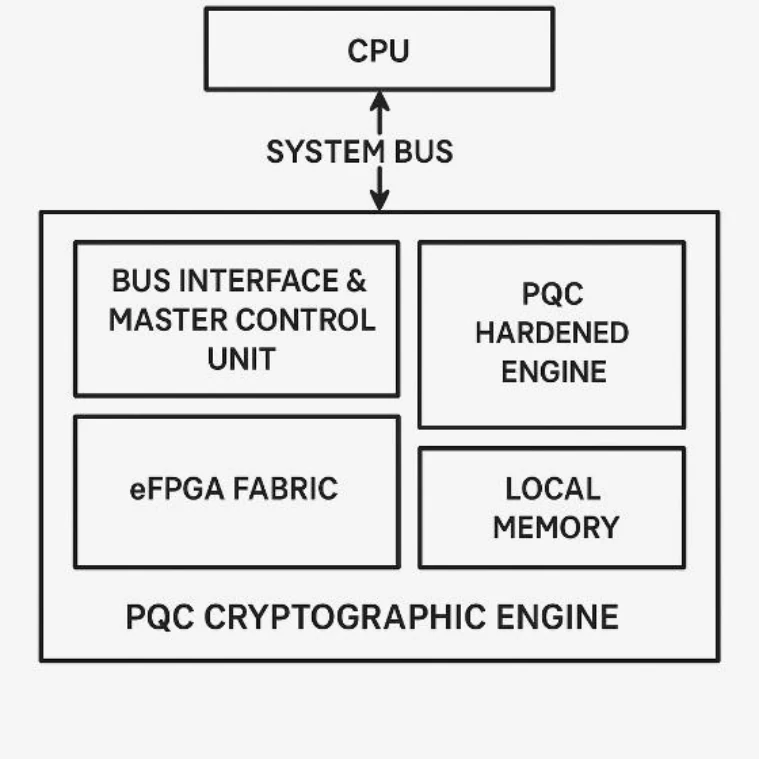
As shown in Figure 1, the coprocessor contains four main components:
- Bus Interface & Master Control Unit: Manages communication with the host CPU and orchestrates the internal data flow.
- PQC Hardened Engine: An ASIC-like block containing dedicated, optimized hardware for performance-critical operations.
- eFPGA Fabric: A block of programmable logic that implements the agile and control-flow-intensive parts of the cryptographic schemes.
- Local Memory: A shared bank of registers and BRAMs for fast, local storage of intermediate values, keys, and polynomials, minimizing traffic on the main system bus.
B. Division of Labor: The PQC Hardened Engine vs. the eFPGA Fabric
The strategic strength of this architecture lies in its intelligent division of labor, assigning tasks to the hardware component best suited for them.
PQC Cryptographic Engine
This engine is designed for maximum performance and efficiency. It handles the stable, well understood, and computationally demanding mathematical primitives that are common across the primary NIST lattice-based standards. Academic research has demonstrated the feasibility of building efficient, unified accelerators that can share resources to perform these operations. The components of this hardened engine would include:
- Unified Number Theoretic Transform (NTT) Unit: A highly parallelized and pipelined hardware block for performing NTT and inverse NTT, the core operations for fast polynomial multiplication. This unit can be designed to handle the different moduli and parameters of both Kyber and Dilithium
- Keccak Core: A dedicated accelerator for the Keccak permutation, which is the foundation of SHA3, SHAKE, and other hashing functions used extensively for random number generation and sampling in both Kyber and Dilithium. Using multiple Keccak cores can allow sampling latency to be hidden behind arithmetic computations
- Basic Polynomial Arithmetic Logic: Hardened units for performing pointwise polynomial multiplication, addition, and subtraction, which can be shared across algorithms.
eFPGA Fabric (Programmable Logic)
The eFPGA serves as the "agile" component of the system, implementing the logic that is most likely to change over the product's lifecycle. It provides flexibility to adapt to new threats, standards, and requirements. Tasks ideally suited for the eFPGA include:
- Top-Level Algorithm Control: The main state machines that sequence the cryptographic operations for Key Generation, Signing, Verification, Encapsulation, and Decapsulation. This control logic relies on the hardened engine to perform the heavy-lifting arithmetic.
- Parameter Set Management: Logic to dynamically switch between different security levels (e.g., Dilithium2, Dilithium3, Dilithium5), which involves adjusting matrix dimensions (k, l), loop bounds, and other security-specific constants.
- Algorithm Variations and Hybrid Modes: The eFPGA can be easily reconfigured to accommodate minor updates or variations in the standardized algorithms. It can also manage the logic for hybrid cryptography, combining a classical primitive with a PQC primitive for a dual layer of security.
- New PQC Algorithm Deployment: This is the ultimate test of agility. In the event of a catastrophic break in lattice-based cryptography, the eFPGA could be reconfigured to implement an entirely different algorithm, such as the code-based HQC. While the hardened NTT engine may not be beneficial for HQC, the Keccak core could still be leveraged, and the entire logic of the new algorithm could be implemented in the programmable fabric, providing a critical fallback path to maintain security without a hardware redesign.
- Advanced and Updatable Side Channel Countermeasures: The eFPGA is the perfect platform for implementing and, more importantly, updating physical security protections. As new side channel attack vectors are discovered, new countermeasures, such as novel masking schemes, random shuffling of operations, or dynamic clock randomization, can be deployed via a simple bitstream update.
VI. Strategic and Economic Benefits of a Programmable PQC Architecture
Adopting a programmable, eFPGA-based architecture for post-quantum cryptography is not just a technical decision but a sound business strategy. It offers tangible benefits in risk mitigation, cost savings, and long-term security posture that are unattainable with fixed-function hardware.
A. Future Proofing and Investment Protection
The primary strategic benefit is futureproofing. For products with long lifecycles, the risk of an implemented cryptographic algorithm being broken or deprecated is significant. A fixed-function ASIC implementing a vulnerable algorithm becomes a "crypto brick," rendering the entire system insecure and potentially requiring a full product recall.
Programmable architecture protects the substantial NRE investment in the SoC design by allowing the cryptographic functionality to evolve in the field, ensuring the product remains secure and compliant throughout its operational life.
B. Reduced Time to Market and Cost Effectiveness
The traditional model of updating cryptography through hardware revisions is slow and extremely expensive. A full silicon respin can cost tens of millions of dollars and take 18 to 24 months. In contrast, developing and deploying a new eFPGA bitstream is a software-level task that can be completed in a matter of weeks.
This drastically reduces the cost and time required to respond to new standards or patch vulnerabilities, enabling organizations to be more responsive to market demands and the evolving threat landscape.
C. Enhanced Security Posture and Rapid Vulnerability Response
Programmable architecture enables a proactive and responsive security posture. If a vulnerability is discovered, either in the mathematical underpinnings of an algorithm or in its physical implementation- a patch can be developed and deployed rapidly via a secure Over-the-Air (OTA) update to the eFPGA.
This capability is especially critical for addressing newly discovered side-channel attack vectors. As researchers discover new methods to extract secrets from physical devices, the countermeasures implemented in the eFPGA can be updated to defend against these emerging techniques, ensuring the device's security posture remains robust over time.
D. Optimized Performance without Sacrificing Adaptability
The hybrid architecture strikes an optimal balance on the performance-flexibility spectrum. By hardening the most computationally intensive and stable operations in dedicated accelerators, the system can achieve the high throughput and low power consumption necessary for demanding applications. Simultaneously, by implementing control logic and evolving functions in the eFPGA, the system retains the critical adaptability needed to navigate the uncertain PQC landscape. This approach delivers the best of both worlds, avoiding the performance penalty of pure software and the rigidity of pure hardware.
VII. Implementation Considerations and Road Ahead
While programmable PQC architecture offers compelling advantages, its successful implementation requires careful consideration of several technical and logistical challenges. From silicon integration to the security of the update mechanism itself, a holistic approach is necessary to realize the full potential of crypto agility.
A. Challenges in eFPGA Integration: Area, Power, and Design Complexity
Integrating an eFPGA core is more complex than adding a standard IP block. It requires a codesign methodology that considers the interplay between the hardened SoC logic and the programmable fabric.
- PPA (Power, Performance, Area): The eFPGA itself consumes static and dynamic power and adds to the overall die area and cost. Architects must carefully budget for the eFPGA size, balancing the need for future flexibility against the immediate PPA impact.
Design Flow: Integrating eFPGA IP requires expertise in both ASIC and FPGA design flows. Depending upon the eFPGA solution of choice, the design flow either requires one of the following three
- Generating the custom eFPGA via SW RTL
- Integration an of an eFPGA hard macro from a third party
- Integration of the eFPGA via chiplet-based multi die packaging
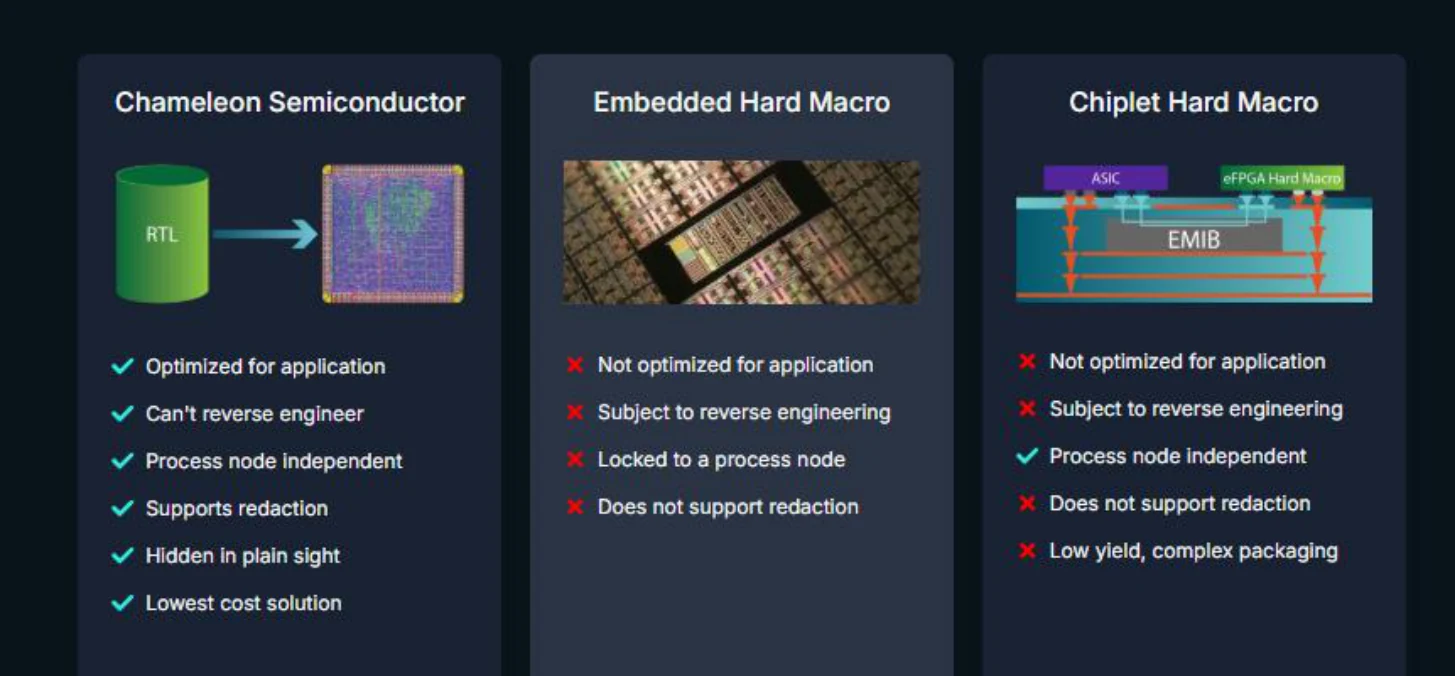
As summarized in Figure 2, the three general types of eFPGAs offer significantly different benefits. In some cases, the limitations of the alternatives can prove to be significant impediments to adoption, to the point of not being practical.
B. Software Tooling and Ecosystem: Development Flows for eFPGA based PQC – The Chameleon Advantage
A robust and user-friendly software toolchain is essential for developing, synthesizing, verifying, and deploying bit streams to an eFPGA. While the commercial ecosystem for eFPGA a significant trend is the shift toward open-source foundations that promote transparency and community-driven development.
The Chameleon Semiconductor eFPGA solution highlights the benefits of such an open-source software flow for enabling fine-grained hardware redaction. In one demonstration CAD flow, designers can mark a security-critical IP block in their Verilog design for redaction. The flow leverages a series of open-source tools to automate the process:
- Yosys is used to synthesize the critical module into LUTs.
- VTR/VPR then places and routes the netlist to automatically determine the smallest eFPGA fabric size required.
- A Chisel-based generator outputs the synthesizable Verilog RTL for the soft eFPGA fabric along with the necessary Static Timing Analysis (STA) constraints for physical design.
- Finally, Python scripts and Cocotb are used for bitstream generation and functional verification, respectively.
A primary benefit of this software flow is its seamless integration into standard ASIC physical design flows, which addresses the challenge of managing mixed ASIC and FPGA designs. By generating a "soft" eFPGA in RTL and providing timing constraints, the approach eliminates the need for specialized tools or custom layouts, thereby improving process portability.
Furthermore, the flow enables design-specific optimization by translating the bitstream into targeted STA constraints, which can significantly reduce performance overheads compared to a generically optimized fabric. This automated and integrated approach exemplifies a powerful, flexible, and secure method for eFPGA-based design.
C. The Criticality of a Secure Update Mechanism for eFPGA Bitstreams
The ability to update the eFPGA in the field is its greatest strength, but it also introduces a critical attack surface. The update mechanism itself must be cryptographically secure to prevent an adversary from loading malicious or unauthorized bitstream.
Chameleon Semiconductor IP security is achieved by "hiding in plain sight" by replacing a security-critical IP block with a generic, synthesizable eFPGA fabric. The functionality of the original IP is not present in the hardware design files sent for manufacturing; instead, it is stored in a secret configuration bitstream that is loaded after fabrication.
The part of the design that is "in plain sight" is the eFPGA itself. An untrusted foundry or a reverse engineer examining the design netlist can see the structure of the eFPGA a standard array of logic blocks and routing channels. However, this generic structure does not reveal the specific logic functions or interconnections of the proprietary IP it is meant to replace.
The actual proprietary IP is "hidden" because its logic and routing details are entirely contained within a secret configuration bitstream. This bitstream is what configures the generic eFPGA to perform the specific, critical function. Without loading the correct bitstream, the eFPGA fabric remains non-functional, and the secret design is never exposed to the untrusted fabrication facility or to post-fabrication reverse engineering efforts.
A comprehensive secure update process must address several key areas:
- Confidentiality: The bitstream contains valuable intellectual property, and its exposure could enable cloning or reverse engineering. Therefore, the bit stream must be encrypted. Modern FPGAs and security solutions provide on-chip AES256 decryption engines that use keys stored securely in one-time programmable eFuses or battery-backed RAM. The bitstream is decrypted on the fly as it is loaded, ensuring the plaintext IP is never exposed on external pins
- Authenticity and Integrity: To prevent tampering, the system must verify that the bitstream originates from a trusted source and has not been altered. This is achieved by cryptographically signing the bitstream. The device uses a hardware root of trust to verify this signature upon boot. For a truly futureproof system, this signature verification should employ a hybrid PQC scheme (e.g., ECDSA combined with MLDSA or the stateful LMS) to protect against quantum attacks on the update mechanism itself.
- Rollback Protection: An attacker might try to load an older, legitimate but vulnerable version of a bitstream to exploit a known flaw. The update mechanism must prevent such downgrade attacks. This is typically accomplished using a secure, monotonic version counter stored in nonvolatile memory on the device.
- Secure Over-the-Air (OTA) Process: The entire end-to-end update process, from the OEM's server to the deployed device, must be secured. This involves adhering to industry’s best practices and standards, such as ISO/SAE 21434 for the automotive sector, to ensure a robust and resilient update pipeline.
D. Industry Collaboration and Standards
Achieving crypto agility on a global scale is not a task for any single company; it requires broad industry collaboration. Recognizing this, numerous standards bodies and industry groups are actively working to define the principles and practices of agile cryptography.
NIST has hosted workshops that bring together experts from academia and industry including major technology companies such as Google, IBM, Intel, and NXP to discuss challenges and strategies. Working groups within organizations like the Internet Engineering Task Force (IETF), the International Organization for Standardization (ISO), and the Accredited Standards Committee X9 (Financial Industry) are developing standards for agile protocols and systems, laying the groundwork for an interoperable, quantum-safe future.
VIII. Conclusion
As the industry transitions to Post-Quantum Cryptography (PQC), the focus must extend beyond algorithmic strength to the underlying hardware's security, agility, and reliability. The successful deployment of PQC will depend on agile hardware platforms that can adapt to evolving standards. Chameleon Semiconductors' advancements in "top-down" physical design methodologies for soft eFPGAs are crucial, offering a "push-button" flow that simplifies the integration of reconfigurable logic and accelerates the development of custom accelerators with significant performance gains over traditional methods.
Furthermore, protecting this valuable PQC intellectual property through the supply chain is paramount. The Chameleon Semiconductors' success in hardware redaction, which conceals critical logic within an eFPGA fabric to protect against reverse engineering in untrusted facilities, shows that robust IP security can be integrated into production EDA flows with minimal impact on power, performance, and area. Furthermore, as the only “on shore” eFPGA supplier that based on entirely software defined RTL.
Finally, for PQC systems deployed in critical environments, operational resilience is non-negotiable. Together, these advances in agile design, supply chain security, and in-field reliability are building the secure hardware foundation necessary for the widespread adoption of Post-Quantum Cryptography.
Copyright © 2026 Chameleon Semiconductor confidential preliminary and subject to change
References
- Cankun Zhaot, N. Z. (2022). A Compact and High-Performance Hardware Architecture for CRYSTALS-Dilithium. IACR. Transactions on Cryptographic Hardware and Embedded Systems, 270-295.
- Dobias, S. R. (2021). Implementing CRYSTALS-Dilithium Signature Scheme on FPGAs. Cryptology Archive, Paper 2021/108.
- Li, W. G. (2023). Highly-Efficient Hardware Architecture for CRYSTALS-Kyber With a Novel Conflict-Free Memory Access Pattern. IEEE TRANSACTIONS ON CIRCUITS AND SYSTEMS - 1.
- Mohan, P. a. (2021). Hardware Redaction via Designer-Directed Fine-Grained eFPGA Insertion. 2021 Design, Automation & Test in Europe Conference & Exhibition.
- Prashanth Mohan, O. A. (2021). Top-down Physical Design of Soft Embedded FPGA Fabrics.
- Prashanth Mohan, O. A. (n.d.). Implementation of Hardware Redaction in a Production EDA Flow.
- Sadeghi, S. (2025, 05 04). Secure and Efficient Signal Processing on FPGA: A Comprehensive Review of Cryptographic, Post-Quantum, and AI-Enhanced DSP Implementations for Embedded Systems. International Journal of Engineering & Technology Sciences (ISSN: 2289-4152).